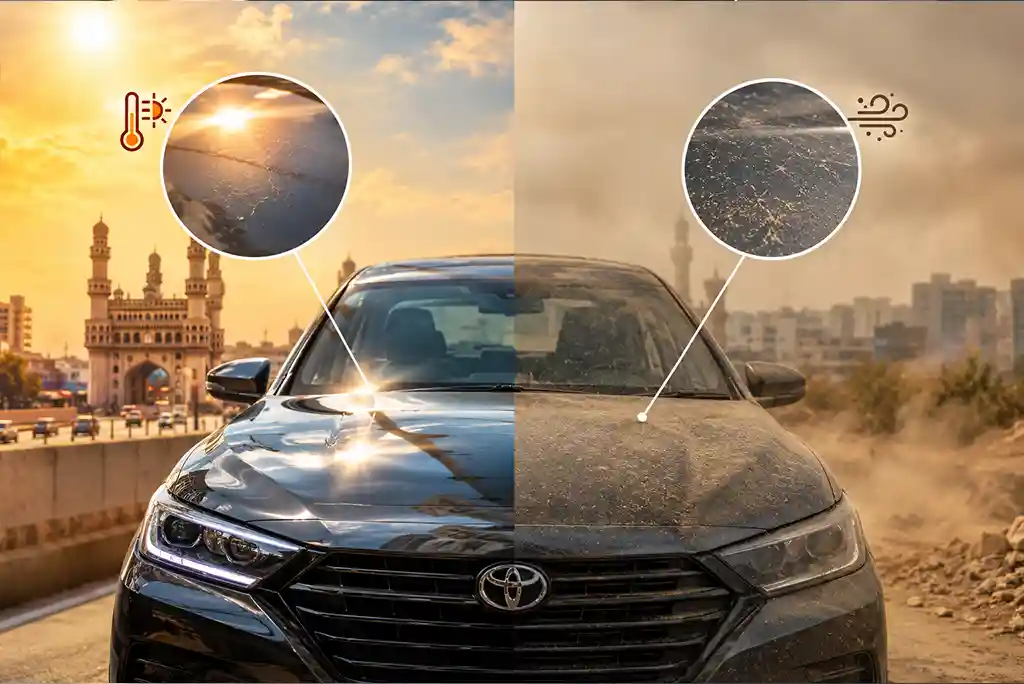
Hyderabad’s climate can be demanding on a car’s exterior. Strong sunlight, high temperatures, airborne dust, road grime and seasonal rain can gradually affect the appearance and condition of automotive paint.
For car owners, understanding these risks makes it easier to choose the right car paint protection in Hyderabad, whether that means regular detailing, a Paint Protection Coating, or PPF for cars.
How Does Hyderabad’s Heat Affect Car Paint?
Prolonged exposure to ultraviolet (UV) radiation can gradually degrade automotive paint and clear coat. The effects may become more noticeable over time as the surface loses gloss, develops oxidation or appears dull.
Heat itself can also make contaminants more difficult to remove. Dust, bird droppings, tree sap and other substances left on a hot surface can become more stubborn and, in some cases, contribute to staining or surface damage.
A simple habit can help: do not leave contaminants sitting on the paint for extended periods, particularly during hot weather.
Why Is Dust a Problem for Your Car?
Dust is unavoidable in a busy city. Hyderabad’s construction activity, traffic and dry conditions can leave fine particles on a vehicle’s surface.
The bigger problem comes when dusty paint is wiped without first rinsing it. Fine particles can act as an abrasive between the cloth and the paint, creating fine swirl marks.
Hyderabad condition | Potential effect on paint |
Strong sunlight | UV-related fading and oxidation |
High temperatures | Faster drying of contaminants |
Road dust | Surface abrasion during improper washing |
Construction dust | Fine particles settling on paint |
Bird droppings | Potential staining if left untreated |
Tree sap | Difficult-to-remove surface contamination |
Monsoon grime | Mud and contaminants accumulating on paint |
How Can You Protect Your Car’s Paint?
The best approach depends on how you use and maintain your vehicle.
Regular Washing
A proper wash removes dust and contaminants before they have time to accumulate. Use automotive shampoo, clean microfiber towels and appropriate washing techniques.
Avoid dry-wiping a heavily dusty vehicle. Rinse the surface first to remove loose particles.
Paint Protection Coating
A Paint Protection Coating creates an additional protective layer over the vehicle’s painted surface. Depending on the product, coatings can provide hydrophobic properties, improve resistance to environmental contaminants and make routine cleaning easier.
Ceramic coatings are one example of this type of protection. However, they should not be considered a substitute for PPF when protection against stone chips and physical impact is the primary concern.
PPF for Cars
PPF, or Paint Protection Film, is a transparent film physically applied to painted surfaces. It is designed primarily to protect against road debris, stone chips, scratches and other forms of physical impact.
For Hyderabad drivers who regularly use highways or congested roads, PPF can be particularly useful on areas such as the front bumper, bonnet, fenders and ORVMs.
PPF vs Paint Protection Coating
Feature | PPF | Paint Protection Coating |
Physical barrier | Excellent | Limited |
Stone-chip protection | Yes | No |
Water repellency | Available with suitable films | Strong |
Easier cleaning | Yes | Yes |
UV/environmental protection | Yes | Yes |
Best use | Physical impact protection | Surface protection and maintenance |
For some vehicles, combining the two can make sense. PPF can protect high-impact areas while a compatible coating can provide additional hydrophobic and maintenance benefits.
Does Parking Matter?
Yes. Parking under direct sunlight every day increases exposure to UV radiation and heat. Whenever practical, use covered parking or shade.
If outdoor parking is unavoidable, regular washing and a suitable paint protection system become more important.
A car that is driven frequently through dusty areas also needs a different maintenance routine from a vehicle that spends most of its time parked indoors.
What Is the Best Car Paint Protection for Hyderabad?
There is no single solution for every vehicle.
Choose PPF if your biggest concern is stone chips, road debris and physical damage.
Choose a Paint Protection Coating if you primarily want easier cleaning, water repellency and additional protection against environmental contaminants.
Consider both if you want broader protection and your budget allows it.
The quality of preparation and installation also matters. A premium protection product cannot compensate for poor surface preparation or incorrect application.
Hyderabad Car Paint Protection: What Should You Do?
For effective car paint protection in Hyderabad, start with good maintenance habits. Wash the car correctly, remove contaminants promptly, avoid abrasive cleaning and reduce prolonged exposure to direct sunlight where possible.
If you are considering PPF for cars, inspect the installation quality, film specifications, warranty and aftercare support before making a decision. Similarly, when choosing a coating, understand exactly what product is being applied and what protection it is designed to provide.
Protecting your car is ultimately about matching the solution to the conditions it faces every day.